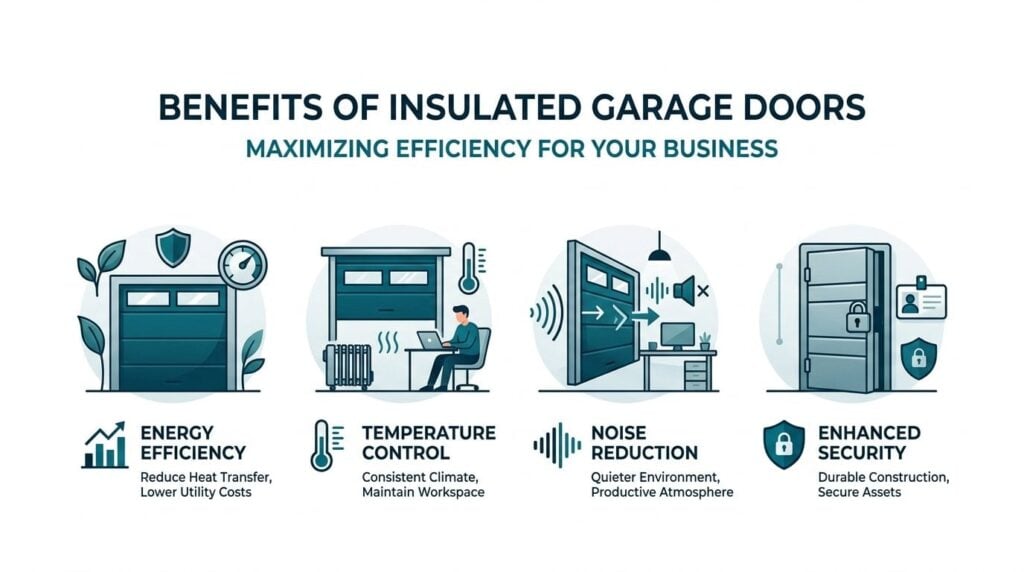
The benefits of an insulated garage door are real, but they’re quieter and more modest than the sales pitch usually suggests. In Raleigh, Knoxville, Detroit and Myrtle Beach, an insulated door mostly buys you a steadier garage temperature, less rattle, and a sturdier panel. It won’t turn the garage into another room of the house. Whether that’s worth the extra cost depends on how you use the space, so here’s what insulation does, what it doesn’t, and how to decide.
What Does Insulation Actually Do to a Garage Door?
A basic non-insulated door is a single layer of thin steel, hollow behind the panel. An insulated door adds a layer of foam, either sandwiched between two steel skins or bonded to the back of a single steel layer. That foam slows heat moving through the panel, and it also stiffens the section.
You’ll see an R-value on the spec sheet. It’s a measure of resistance to heat flow, and higher means better. Treat the number with some caution. Manufacturers test and rate their panels in different ways, so comparing one brand’s figure to another’s isn’t always apples to apples. And the rating describes the panel, not the whole installed door. Gaps at the edges, a tired bottom seal, and the joints between sections all let air through, so the real-world result is always lower than the label suggests.
Polystyrene vs. polyurethane
Polystyrene is usually a cut foam board fitted into the section. It’s lighter and typically costs less. Polyurethane is injected as a liquid and expands to fill the section, bonding to the steel. That generally makes it denser and stiffer, and the door feels more solid. Both are legitimate choices; which one fits depends on budget and how much you’ll use the garage.
How Much Will It Help With Comfort and Energy in Our Climate?
Garages in Raleigh and Knoxville take a beating from hot, muggy summers, and a closed-up garage can get far hotter than the outdoor air by late afternoon. Myrtle Beach winters are mild but damp, and a cold snap can still leave a garage feeling raw. In any of these towns, an attached garage passes some of that swing into the house.
That matters most when there’s living space touching the garage. A lot of newer subdivisions around Wake County and Knox County put a bonus room or a bedroom right over the garage, and those rooms are the ones people complain about: too warm in July, chilly in January. An insulated door takes the edge off those swings.
Now the honest part. Insulation softens the temperature, it doesn’t control it. If the bottom seal is cracked, the side stops are loose, or the shared wall between garage and house has no insulation, much of the benefit leaks away. A great door on a leaky opening will underperform a decent door that’s sealed well.
If you want a verified figure for what insulating a garage can do for energy use, the U.S. Department of Energy covers garage insulation on Energy.gov. I’d rather point you there than throw out a savings percentage that depends so much on your house.
Are Insulated Doors Quieter, Stronger, and Better Looking?
This is where many homeowners are surprised. The foam dampens the rattle of the sections and the rumble of the opener, which you notice right away if your bedroom sits above or beside the garage. A 6 a.m. departure gets a lot less dramatic.
Strength is the other perk. Thin hollow panels dent easily. A bike handlebar, a basketball, or a teenager’s first car can leave a mark. Insulated sections with foam behind the steel resist that kind of damage better and tend to feel more solid when you push on them.
Our humid climate is hard on any door, and Myrtle Beach adds salt air, which attacks hardware and finishes faster than inland weather. Steel with a quality finish holds up well, but only if you look after it. Rinse the door with fresh water now and then, especially after a coastal storm, and check the finish and the fasteners for early rust. Small chips are easy to touch up. Neglected ones aren’t.
Insulated doors also come in plenty of styles, from traditional raised panels to carriage-house looks and flush modern designs, so finding one that suits a planned community or an older neighborhood isn’t hard. If you’re in an HOA, check with them before you order.
What Should You Know About Cost, Weight, and Opener Fit Before Buying?
Insulated doors cost more upfront than non-insulated ones. Pricing varies with size, insulation type, windows, and style, and it changes over time, so the only number worth trusting is an on-site quote.
The less obvious cost is weight. An insulated door is heavier, and the springs have to be matched to it. Dropping a heavier door onto springs sized for a lightweight one is a mistake we see fairly often. The door feels heavy, the opener strains, and the springs wear out early or snap. A proper install means checking the springs and balance, and often replacing them. It’s also worth confirming your opener has the strength and settings for the new weight. If it’s an older unit, that can be the moment to look at a smart upgrade.
Weather seals deserve attention too. A good bottom seal and snug side and top stops help keep out wind-driven rain, which matters during hurricane season near Myrtle Beach and in the heavy thunderstorms that roll through Raleigh and Knoxville. Humidity also makes old rubber go stiff and flat, so seals don’t last forever here.
One more distinction: an insulated door is not automatically a hurricane or high-wind-rated door. Wind-rated doors are a separate specification with their own requirements. If you’re in a coastal zone, check your local code before choosing, since requirements differ by area.
Is an Insulated Garage Door Worth It for Your Home?
The strongest case is an attached garage, especially with a room above it, or any garage you actually spend time in: a workshop, a home gym, a place where the kids hang out. You’ll feel the difference in comfort and noise.
The case gets weaker for a detached garage that mostly stores a mower and holiday boxes. You’d be paying for performance you rarely use, though the dent resistance still has some value.
Don’t assume you need a whole new door, either. If yours is in good shape, new seals or a spring tune-up may do more for comfort than a replacement. Gaps are often the real culprit.
That’s how we approach it at Skylift Garage Doors. We look at your current door, springs, and opener on site before recommending anything, and if a replacement makes sense, we’ll tell you why. Once the new door is in, our Skycare Club Membership covers annual maintenance, which helps keep springs balanced and seals in shape through humid summers and stormy seasons.
Quick Answers About Insulated Garage Doors
No. It reduces the swings, but without heating or cooling the garage will still follow the weather.
DIY kits exist. The catch is the added weight, so the spring balance has to be rechecked afterward, and the door needs to be in good condition to begin with.
Not by insulation alone. Lifespan depends on the build quality, the finish, the install, and how well it’s maintained.
It can cut down on condensation forming on the door surface, but it won’t dehumidify the garage.
Who Gets the Most Out of an Insulated Door?
If your garage is attached and you actually use it, insulation usually pays off in comfort, quiet, and a sturdier door. If it’s mostly storage, you may do just as well with good seals and a well-tuned system. Not sure which camp you’re in? Skylift Garage Doors will take a no-pressure look at your current door and give you an honest recommendation. Schedule Now!
Call Your Local Team(844) 755-5149