What Raleigh, Knoxville, Myrtle Beach and Detroit Homeowners Should Know
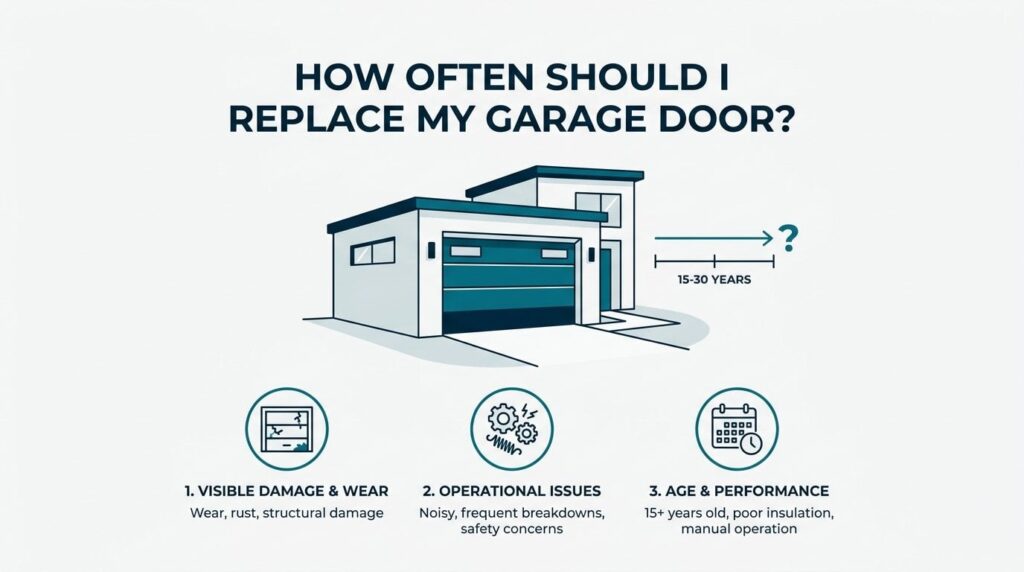
Most garage doors last somewhere between 15 and 30 years, but age alone rarely tells you when it’s time to replace one. What matters more is how many times the door has cycled, what the weather has done to it, and whether the problem in front of you is a worn part or a worn-out door. Here’s how we think about it for homes in Detroit, Raleigh, Myrtle Beach, and Knoxville.
What Is a Realistic Lifespan for a Garage Door?
These are typical ranges, not guarantees. Steel doors commonly run about 15 to 30 years. Wood can reach a similar range, but only with regular refinishing and attention. Aluminum and vinyl vary quite a bit. Build quality and maintenance usually matter more than the material on the spec sheet.
Cycles matter more than calendar years. A standard torsion spring is often rated for around 10,000 cycles, and one cycle is one trip up and one trip down. A family that opens the door four to six times a day can reach that in roughly five to seven years. The door itself may be perfectly fine at that point. The springs just need replacing.
Parts wear at different rates
Springs and cables take the most stress and go first. Rollers wear next, then the opener, usually somewhere in the 10 to 15 year range. Weather seals harden and crack along the way. The panels and tracks are the long-lived pieces. So “my spring broke” and “my door is finished” are two very different conversations.
How Does Our Weather Change the Timeline?
Climate can take years off a door, or add them back if you stay on top of it.
Myrtle Beach. Salt air and humidity are hard on metal. Springs, hinges, tracks, and fasteners corrode faster near the coast, and rust on a spring makes it weaker and more likely to snap. Hurricane-season winds and flying debris can also bend panels and tracks. A regular fresh-water rinse and a coat of garage-door lubricant go a long way here.
Raleigh. Summer humidity and heavy rain are rough on wood doors and bottom seals. Bottom panels swell, and seals can rot. The temperature swings from a hot July to a chilly January make weather stripping brittle over time. Raleigh also has a lot of fast-growing suburban neighborhoods, and many of those builder-grade doors are now approaching 15 to 20 years. Plenty of them are thin and lightly insulated to begin with.
Knoxville and East Tennessee. Freeze-thaw cycles work on seals and bottom panels, and a cold snap stiffens lubricant, which makes springs and openers work harder. Hilly lots add another problem, since water tends to pool at the base of the door and speeds up rust and rot at the bottom edge.
One more thing that applies everywhere: a thin, uninsulated single-layer door in a hot, humid garage can warp and dent. It also lets heat straight through to any room attached to the garage.
When Is a Repair Enough?
A lot of garage door problems look dramatic but are fixable. A broken spring, a frayed cable, a door that’s jumped the track, noisy rollers, a worn-out weather seal, or an opener that’s quit are all usually part-level fixes, often on a door that’s otherwise in good shape.
A reasonable rule of thumb: if the damage is limited to one component and the door is structurally sound, repair usually makes sense. A broken spring doesn’t mean the door is dead. It usually just means the spring hit its cycle limit.
Springs and cables are under serious tension, so this is a job for a trained technician, not a weekend DIY project. People get hurt every year trying to wind or release them. It’s not worth the risk to save a service call.
At Skylift, the usual fixes are broken spring replacement, cable repair, and opener repair. If your opener is older, a smart opener upgrade often makes more sense than repairing it again, since you get app control and alerts along with a fresh motor.
When Should You Replace the Whole Door?
Replacement starts to make sense when the problem is the door itself, not a part attached to it. Watch for these:
Rust-through or rot on several panels, not just one spot at the bottom
Panels that keep buckling or cracking
A door that repeatedly goes out of balance, even after the springs have been serviced
Storm or vehicle damage across multiple panels
Matching is a real issue with damage. If a panel is crushed and the model has been discontinued, replacing just that section may not be possible, or it may leave you with a patchwork door. Coastal homeowners who’ve been through a hurricane season know this one well.
When repairs add up
Keep track of what you’ve spent. If repeated service calls are getting close to the cost of a new door, replacing it usually makes more sense. Prices change, so ask for a current quote on both options and compare them side by side before deciding.
Safety and comfort
Very old openers may lack auto-reverse sensors, which is a safety problem worth fixing no matter what the door looks like. And if your garage doubles as a workshop, gym, or play space, a noisy, drafty, uninsulated door is worth upgrading even if it still moves. A good insulated door makes a noticeable difference in our hot, humid summers.
One caution: newer isn’t automatically better. Quality and insulation vary a lot between doors, so look at construction, not just the price tag.
How Can Simple Upkeep Stretch a Door’s Life?
Twice a year is plenty for most homeowners. Each time:
Look over the springs, cables, rollers, and hinges for rust, fraying, or gaps.
Lubricate the moving parts with a garage-door-specific lubricant, not a heavy grease.
Disconnect the opener and lift the door by hand. It should feel fairly light and stay put about halfway up. If it drops or shoots up, the balance is off and you need a technician.
Test the auto-reverse by placing a board or roll of paper towels under the door as it closes. It should reverse on contact.
Timing helps. On the coast, do it before hurricane season. In Raleigh, a check after the spring pollen and heavy rains catches swollen or damp bottom seals. In Knoxville, get it done before the first freeze so the lubricant and seals are ready for the cold.
Replace the bottom seal when it cracks or flattens. It’s an inexpensive part, and it keeps out water, pests, and debris that otherwise work on the door’s bottom edge.
If you’d rather not think about it, our Skycare Club Membership has a technician handle the yearly inspection for you.
What Else Do Homeowners Ask About Replacement?
Often, yes. Garage door replacement regularly shows up as a strong-return project in Remodeling magazine’s Cost vs. Value report, and curb appeal is a big reason, since the door takes up a large share of the front of many homes. Returns vary by year and market, so we won’t quote a figure here.
Sometimes, if your door model is still available and the replacement matches. On older or discontinued doors, it often isn’t an option.
It’s worth considering. A new door can change how the opener performs, and newer openers bring better compatibility, quieter operation, and smart features. If your opener is already 10 or more years old, doing both together often makes sense.
For a standard residential door, usually about a day. Custom doors or complicated setups can take longer.
Age Is a Guide, but Condition Makes the Call
A 20-year-old door in good shape can outlast a 12-year-old one that’s been through salt air or a few hard freezes. Look at the condition of the panels, how often you’re paying for repairs, and whether the door still operates safely. Those things decide it, not the number on the install date.
If you’re not sure which side of the line your door is on, we’re happy to take a look. Our technicians in Raleigh, Myrtle Beach, and Knoxville will give you an honest repair-versus-replace recommendation, and if a repair is all you need, we’ll tell you that.