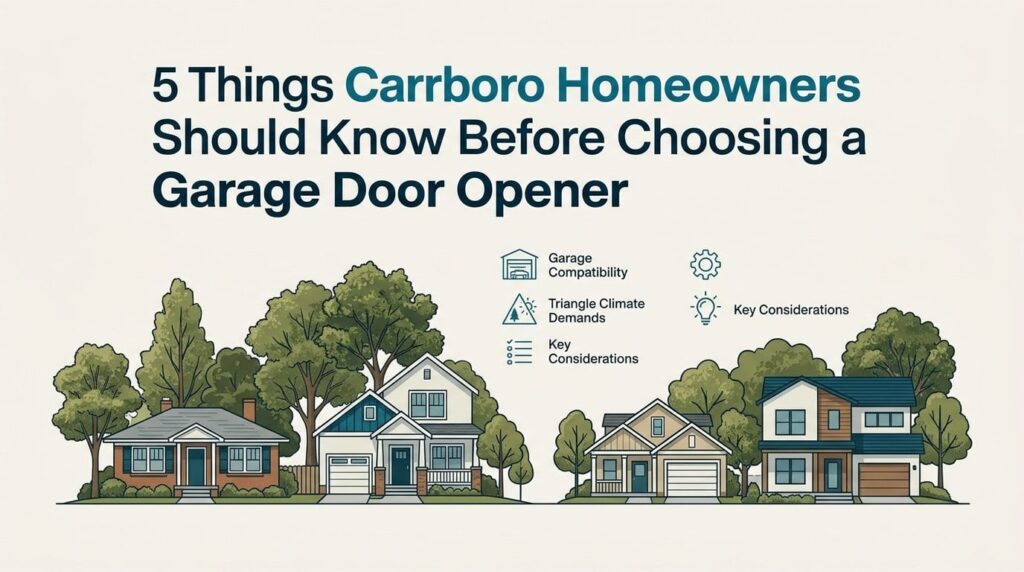
Carrboro is a town that doesn’t fit a single mold. You’ve got craftsman bungalows near downtown on Roberson Street, newer builds out toward the Meadowmont Village edge, older ranch-style homes off Jones Ferry Road, and everything in between. With that mix of housing stock comes a wide range of garage configurations, door weights, and opener needs.
Add in the Triangle’s notorious humidity, summer heat that pushes into the low-to-mid 90s, and the occasional ice storm in January, and choosing the right garage door opener becomes more than just picking a brand off a shelf. This isn’t a complicated decision, but it is one worth thinking through before you buy. Here are five things worth knowing first.
1. Does Your Garage Setup Actually Support the Opener You’re Eyeing?
Why This Matters in Older Carrboro Homes
Homes near downtown Carrboro, particularly along Lloyd Street, Davie Road, and the streets surrounding the Weaver Street Market area, were often built in the 1950s through 1970s. Many of these properties have single-car garages with lower ceiling clearance, non-standard door widths, or older electrical wiring that wasn’t designed with a modern opener in mind.
Some detached garages and converted carriage-house structures in this part of town have overhead clearance as low as six inches above the door, which rules out certain trolley-style rail systems entirely. If you order an opener based on what you saw at a home improvement store without measuring first, you may end up with a unit that physically won’t fit your space.
What to Check Before You Buy
Before settling on any opener model, take a few measurements: ceiling height above the door, available headroom, and the horizontal depth of your garage. Also check whether your garage has a dedicated 120V outlet near the ceiling. Older homes sometimes don’t, which means adding an opener involves an electrician visit too.
Newer construction along NC-54 and in communities near the Meadowmont Village corridor typically has standard two-car attached garages with modern wiring and plenty of headroom. Those homes have far fewer compatibility surprises. But if your home predates 1985, it’s worth a closer look before committing to a specific unit.
2. How Does Carrboro’s Humidity and Heat Affect Opener Longevity?
The Climate Reality for the NC Piedmont
From roughly April through October, Carrboro sits in sustained heat and humidity that’s tough on mechanical components. The NC Piedmont receives around 45 to 50 inches of rain annually according to general NOAA regional data, and the combination of moisture and heat accelerates corrosion on metal tracks, springs, and hardware. Opener motor housings that aren’t well-sealed can trap moisture and degrade from the inside out over time.
This isn’t unique to Carrboro, but it’s more pronounced here than in drier climates. If you’ve ever noticed rust forming on your garage door’s torsion spring or bottom bracket hardware, that’s the same environment your opener is living in every day.
What to Look For in an Opener
Look for units with sealed or enclosed motor housings rather than open-frame designs. Corrosion-resistant hardware and quality weather sealing on the motor unit itself make a real difference over a five-to-ten-year lifespan in this climate. DC motor openers also tend to run more smoothly and quietly than older AC motor designs, and they generally handle temperature variation better.
It’s a small upfront consideration that pays off down the road, especially if your garage isn’t climate-controlled.
3. Which Drive Type Is Right for Your Home’s Layout?
Chain, Belt, or Screw: What’s the Difference?
Drive type is one of the most practical decisions you’ll make, and it often comes down to where your garage sits relative to your living space.
Chain drive: Durable and cost-effective, but produces noticeable vibration and noise. Fine for a detached garage or a setup where no one sleeps or works directly above or beside it.
Belt drive: Significantly quieter and smoother. A strong choice for craftsman bungalows and townhomes where the garage wall is shared with a bedroom or home office. This is the drive type we most commonly recommend for Carrboro’s older attached garages.
Screw drive: Fewer moving parts, but more sensitive to temperature swings. In a region that goes from freezing rain in January to humid 90-degree summers by July, screw drive systems can require more attention to lubrication and adjustment than belt or chain alternatives.
The Noise Factor in Denser Neighborhoods
In Carrboro’s walkable neighborhoods near downtown, homes are often closer together, and garages are attached or semi-attached. If someone in your household leaves early in the morning or comes home late, a chain drive opener grinding away at 6 a.m. is going to get noticed. A belt drive system is a genuinely better fit for that kind of daily use pattern.
4. Which Smart Opener Features Are Worth It for Carrboro Households?
Battery Backup Is a Practical Must-Have
The Triangle sees its share of power outages. Summer thunderstorms, occasional tropical systems that push inland from the coast, and winter ice events can all knock out power for hours at a time. If your opener doesn’t have battery backup and the power goes out, you’re either manually releasing the door or your car is stuck inside.
Battery backup is no longer a premium add-on on most mid-range and higher openers. It’s worth paying for, especially if you rely on your garage as your primary entry point.
Wi-Fi and Cameras: Useful, Not Gimmicky
For households where residents commute to UNC, Research Triangle Park, or downtown Chapel Hill and Durham, app-based opener control is genuinely convenient. You can check whether you left the door open, close it remotely, and get alerts when the door activates. That’s useful without requiring a full smart home setup.
Integrated cameras on newer opener models add a security layer without needing a separate device mounted in your garage. For rental properties or homes with college-age residents near the UNC campus, that kind of visibility is worth having.
That said, if you’re not interested in smart features, a reliable standard opener with battery backup is still a solid choice. Don’t pay for tech you won’t use.
5. Why Does Professional Installation Actually Matter?
It’s More Than Just Mounting a Box to the Ceiling
Opener installation involves calibrating the force settings to match your specific door’s weight, aligning the trolley and rail system, adjusting the travel limits, and verifying that the safety reversal mechanism works correctly. These aren’t one-size-fits-all settings. A door that’s heavier due to insulation, or one with a worn torsion spring, needs force settings calibrated differently than a standard lightweight door.
Get this wrong and you’re looking at a door that reverses unexpectedly, strains the opener motor, or worse, doesn’t stop when it should. That’s a safety issue, not just an inconvenience.
Local Knowledge Catches What Generic Instructions Miss
A technician who regularly services homes in Carrboro and Chapel Hill knows the quirks that come with older housing stock in this area: low headroom situations off Jones Ferry Road, detached garages with unusual door weights near downtown, two-car doors in newer NC-54 corridor developments that need higher-horsepower units. That local familiarity matters when you’re dealing with a home that doesn’t match a standard template.
DIY installation is possible in straightforward situations, but if your garage has any of the non-standard characteristics common in older Carrboro homes, having a professional handle it the first time is the better call.
Getting It Right the First Time
Picking the right opener isn’t complicated once you understand what your home actually needs. For Carrboro homeowners, that means accounting for your garage’s age and layout, the region’s humidity and heat, the drive type that fits your noise tolerance and living situation, and how much smart functionality genuinely adds value to your daily routine.
Skylift Garage Doors services the Carrboro and Chapel Hill area and can walk you through the right fit for your specific setup. Whether you’re in a 1960s bungalow near Roberson Street or a newer townhome off NC-54, we’d rather help you get it right the first time than troubleshoot a mismatch six months down the road.
Ready to get started? Schedule Now!