Most torsion springs on a typical home garage door are rated for about 10,000 cycles. For many families that works out to roughly 7 to 10 years, but garage door spring lifespan can swing a lot depending on how often you use the door and where you live. Salt air in Myrtle Beach, humid summers in Raleigh, and cold-morning, warm-afternoon swings in Knoxville all take a toll. If your door just banged, feels heavy, or is closing in on that 7-year mark, here is how to tell normal wear from a spring that is about to let go.
How Is Garage Door Spring Lifespan Really Measured?
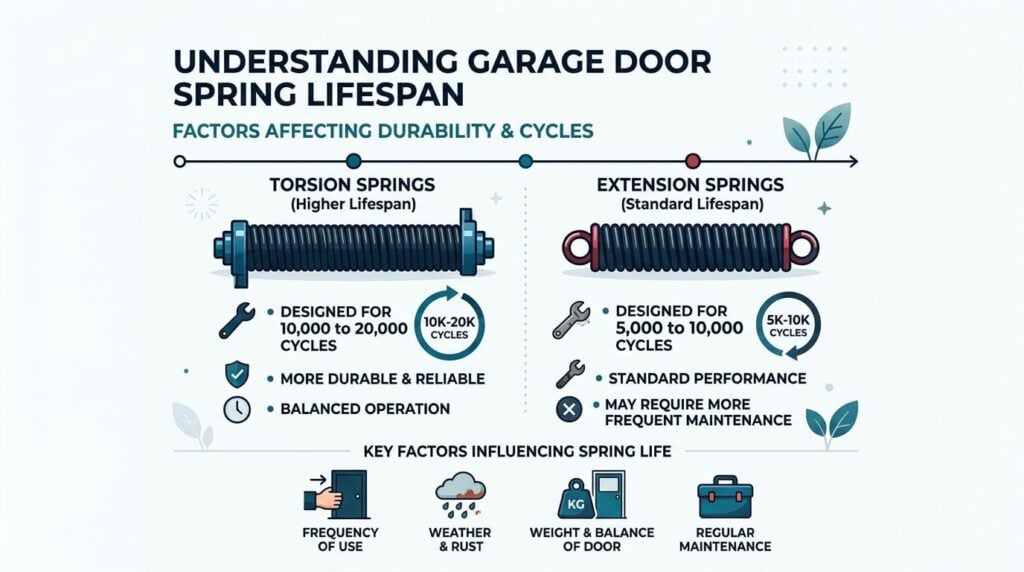
A cycle is one full open and one full close. Standard springs are commonly rated around 10,000 cycles, and higher-cycle springs are often rated from 15,000 to 25,000 or more. Ratings vary by manufacturer and spring size, so the only way to know what you have is to check the specs on the spring that is actually installed.
What does that look like in real years?
Suppose a family makes about 4 trips out per day. Each trip opens the door twice, once leaving and once coming back, so that is about 8 cycles a day. Over a year, 8 x 365 comes to roughly 2,900 cycles. A 10,000-cycle spring would last around 3.5 years in that house.
Now take a two-trip household. That is about 4 cycles a day, or roughly 1,450 a year, which stretches the same spring to around 7 years. Treat these as estimates, not promises. But they explain why one neighbor’s spring lasts a decade while another’s quits at year four.
Torsion or extension?
A torsion spring is a coil mounted on a bar above the door. An extension spring runs along the horizontal tracks and stretches as the door closes. Torsion springs generally outlast older extension springs and lift the door more smoothly, which is why torsion is the common setup on newer homes.
What Wears Springs Out Faster Around Raleigh, Knoxville, and Myrtle Beach?
Steel doesn’t care about the calendar, but it cares a lot about moisture and heat.
Myrtle Beach. Coastal salt air and constant humidity speed up rust on bare steel springs and hardware. Rust makes the coils bind and rub, and a rusty coil is far more likely to fracture. It’s worth a look after hurricane season or any storm that pushes wind-driven rain into the garage.
Raleigh and Knoxville. Humid summers combined with big temperature swings keep the metal expanding and contracting. Dry, unlubricated springs can stiffen and groan. A closed-up garage in July can also run far hotter than the outdoor air, and that is hard on springs, cables, rollers, and weather seals alike.
Is your spring sized for your door?
Door weight matters as much as weather. A heavy insulated door, a wood-look door, or a door that picked up a window package after install may be too much for a spring sized for something lighter. The spring then works harder every cycle and wears out early.
This comes up often in newer suburban neighborhoods around Raleigh and Knoxville, where insulated doors are standard. If a spring was swapped before without anyone weighing the door, the sizing may be off. A proper replacement matches the spring to the door, not just to what was there before.
What Are the Signs a Garage Door Spring Is Close to Failing?
What can you see?
- Rust or orange dust on the coil, especially near the ends
- A visible gap in the coil, which means it has already broken
- A door that sags on one side or looks crooked as it closes
What can you feel and hear?
A door that feels heavy when you lift it by hand with the opener disconnected is a red flag. So is a door that slams down, or an opener that strains and groans on the way up. And if you hear a loud bang from the garage, with nobody near the door, a snapped spring is the usual culprit.
Isn’t a struggling opener just a bad opener?
Usually not. The opener doesn’t lift the weight of the door. The springs do. The opener mostly guides the door along while the springs carry the load. When a spring weakens or breaks, the opener ends up doing a job it was never built for, so it grinds, stalls, or reverses. Replacing the opener in that situation just wears out the new one, so have the springs checked first.
Why Replace Springs in Pairs and Leave It to a Pro?
If your door has two springs and one breaks, the other has the same age and the same cycles on it. It’s usually close behind. Replacing both is common practice, and it saves you a second service call a few weeks later.
Safety is the bigger reason. Garage door springs hold a huge amount of tension, and adjusting or removing them without training can cause serious injury. We don’t recommend DIY spring work, and you won’t find step-by-step instructions for it here.
On a typical spring visit, a Skylift technician matches the spring size to your door’s actual weight, replaces cables or rollers if they’re worn, balances the door, and checks that the opener is working properly. If you’re local, here are our spring pages:
- Garage door spring repair in Raleigh
- Garage door spring repair in Knoxville
- Garage door spring repair in Myrtle Beach
What Simple Habits Help Springs Last Longer?
Lubricate a couple of times a year. Use a garage door lubricant made for the job and check the manufacturer’s guidance. Wipe off rust and grime first, especially in humid months and anywhere near the coast.
Run a quick balance test twice a year. Close the door fully, then disconnect the opener. Lift the door by hand to about waist height and let go. A balanced door stays put, or nearly so. If it drops or shoots up, stop and call a pro. Don’t try to adjust anything yourself.
Consider a better spring. If the garage is your family’s main entrance and the door cycles a lot, a higher-cycle or coated spring can be worth the upgrade. It costs a bit more up front but spreads that cost over many more years of use.
Catch wear early. Our Skycare Club Membership includes annual tune-ups, so a technician can spot rust, uneven wear, or a mismatched spring before it fails on a Monday morning.
What Do Homeowners Ask Most About Spring Lifespan?
Can a spring break without warning?
Yes. Many springs show rust or a heavy-feeling door first, but plenty let go with no obvious sign beforehand.
Does cold weather break springs?
Cold can stress a spring that’s already worn or rusty, but wear and corrosion are the main causes. Cold snaps often just get blamed for a break that was coming anyway.
Is it normal for a spring to break after 7 years?
Yes, especially with a standard 10,000-cycle spring and a busy household. It’s about what the math predicts.
How much does replacement cost?
It depends on the spring type, the door size and weight, and whether other parts need attention. We’d rather give you an accurate quote than a guess.
Skylift has local technicians serving Raleigh, Knoxville, Detroit, and Myrtle Beach.
Should You Wait for the Bang or Get the Spring Checked Now?
Springs wear out by cycles and local conditions, not by a fixed date on the calendar. A busy household in humid, salty Myrtle Beach may be done in four years, while a quiet one in Raleigh or Knoxville may get ten. If your spring is around 7 years old, rusty, or your door feels off, an inspection costs far less than a stuck door and a missed morning. Call Skylift Garage Doors for a spring inspection or replacement in your city before it snaps.
[book_online_button]