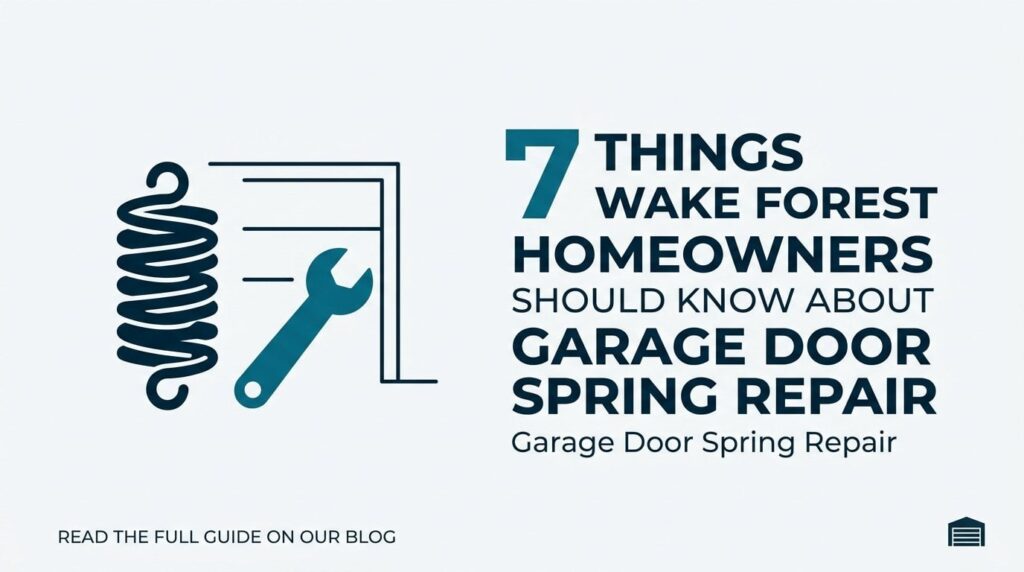
If you live in Wake Forest and your garage door has been acting up lately, there’s a good chance the springs are trying to tell you something. Springs are the real workhorses of your garage door system. They do the heavy lifting every single time that door opens and closes, and in a busy household in Heritage, Traditions, or Hasentree, that adds up fast.
Wake Forest’s climate doesn’t make things easier. North Carolina’s temperature swings, from cold, icy winters to hot and sticky summers, put real stress on metal components. Add in the Triangle’s consistently high humidity, and you’ve got conditions that wear springs down faster than homeowners typically expect.
When a spring finally gives out, the door usually stops working entirely. The opener motor alone can’t lift the door without the spring’s counterbalance, so you’re stuck. It happens fast, it’s inconvenient, and it often catches people off guard.
The good news is that knowing what to watch for, understanding what the repair actually involves, and taking a few simple steps along the way can save you time, money, and a lot of frustration. Here’s what every Wake Forest homeowner should know before a spring issue becomes a full-blown emergency.
1. Catch the Warning Signs Before the Spring Snaps
The Problem It Points To
Most spring failures don’t happen without warning. The trouble is, the early signs are easy to write off as “just how the door sounds now” until the morning it won’t open at all.
What to Watch and Listen For
Pay attention to these signals. A grinding or squeaking noise during operation, especially if it’s new, often means the spring coils are dry or starting to wear. A door that feels noticeably heavier when you try to lift it manually is another red flag. If your opener strains, slows down, or reverses before the door fully opens, the motor is working too hard because the spring isn’t doing its share.
Uneven movement is also a giveaway. If one side of the door seems to lag or the door looks slightly tilted as it moves, the spring tension may be off.
Implementation Steps
1. Test your door manually once a month by disconnecting the opener and lifting by hand. It should feel balanced and light at about waist height.
2. Listen during operation. New sounds are worth paying attention to, not ignoring.
3. If anything feels off, call a technician before the spring fails completely. Catching it early is almost always cheaper than an emergency repair.
Pro Tip
Early spring service is significantly less disruptive than a door that won’t open on a workday morning. In busy Wake Forest households where the garage is the main entrance, that timing matters.
2. Know Which Type of Spring System You Have
Why It Matters
Not all springs are the same, and knowing which system is on your door helps when you call for service and sets realistic expectations for the repair.
Torsion vs. Extension Springs
Torsion springs are mounted horizontally on a bar directly above the door opening. They work by twisting to store and release energy. Most newer homes in Wake Forest subdivisions built in the 2000s and beyond use torsion spring systems. They’re generally more durable and considered safer than the alternative.
Extension springs run along the horizontal tracks on either side of the door and stretch when the door closes. You’ll find these more often in older homes or garages with lower ceiling clearance. They’re still common in parts of Wake Forest, particularly in older neighborhoods.
Implementation Steps
1. Look above your door when it’s closed. A thick coiled spring on a metal bar means torsion. Springs along the side tracks mean extension.
2. Mention which type you have when you call for service. It helps the tech come prepared with the right parts.
3. If you’re not sure, that’s completely fine. A good technician will identify the system immediately on arrival.
Pro Tip
If your home was built in the last 15 to 20 years in a planned Wake Forest community, torsion springs are the most likely setup. It’s a reasonable assumption until confirmed otherwise.
3. Spring Repair Is Not a Safe DIY Project
The Real Risk
This isn’t about doubting your skills. Garage door springs are under extreme mechanical tension at all times, and that tension doesn’t disappear when the spring breaks. A torsion spring stores significant energy that must be carefully released and re-wound using specialized winding bars and precise calibration. Getting that wrong causes serious injuries.
What a Trained Tech Does That You Shouldn’t Try
A professional technician uses the correct winding bars to safely release and reset tension. They calibrate the spring to the exact weight of your door. They also inspect the cables, drums, and hardware at the same time, because a broken spring often stresses these components too. That full-picture assessment is part of what you’re paying for.
The International Door Association and industry professionals consistently advise against DIY spring replacement. This is a well-established safety concern, not a sales pitch.
Implementation Steps
1. If a spring breaks, disconnect the opener and leave the door in place. Don’t force it open manually.
2. Call a qualified garage door technician. This is not a job to hand off to a general handyman either.
3. Keep the area around the door clear until the repair is done.
Pro Tip
The cost of a professional spring repair is modest compared to an emergency room visit. There’s no version of this where DIY is the smarter financial choice.
4. Wake Forest Weather Wears Springs Down Faster Than You’d Think
The Local Factor
North Carolina’s climate is genuinely tough on garage door hardware. Wake Forest sits in the Triangle corridor where winters bring sharp temperature drops, occasional ice, and freezing conditions that make metal coils brittle and more prone to snapping under tension. Then summer arrives with heat, heavy rain, and humidity that lingers for months.
What’s Actually Happening to Your Springs
Metal expands in heat and contracts in cold. When that cycle repeats hundreds of times across a North Carolina year, the coiled wire in your springs experiences cumulative fatigue. The high humidity in the Triangle, especially from spring through fall, accelerates surface corrosion on the coils, cables, and hardware. You may notice rust or flaking on older springs after a humid summer. That’s a sign the spring is approaching the end of its useful life.
Add in the daily use patterns of a busy Wake Forest household, where the garage door may open and close six to ten times a day, and springs reach their cycle limit faster than homeowners expect. Neighboring communities like Youngsville and Zebulon face the same regional wear conditions.
Implementation Steps
1. Inspect your springs visually each fall before temperatures drop. Look for rust, flaking, or visible gaps in the coils.
2. Pay extra attention after a hot, humid summer when corrosion is most likely to show up.
3. Schedule a tune-up in early fall to catch wear before the cold season stresses the springs further.
Pro Tip
Late fall and winter are when spring failures spike in this region. Cold metal and high tension are a bad combination. Getting ahead of it before December is worth the effort.
5. Here’s What Actually Happens During a Professional Spring Repair
Setting Realistic Expectations
If you’ve never had a spring replaced before, it’s natural to wonder what you’re actually paying for and how long it takes. Most homeowners are surprised by how efficient the process is.
The Repair Visit From Start to Finish
A technician will arrive, assess the spring system, and identify the exact spring specifications needed for your door’s weight and size. They’ll safely release the tension on the broken spring, remove it, and install the replacement with proper tension calibration. The whole process typically takes under an hour for a straightforward torsion spring replacement.
A good tech won’t stop at just the spring. They’ll check the cables for fraying, inspect the drums, look at the hardware, and test the door balance before they leave. This is standard practice for a quality repair visit, not an upsell.
Implementation Steps
1. Clear the area around the garage door before the technician arrives.
2. Let the tech do a full inspection, not just the spring. It’s worth the few extra minutes.
3. Ask questions. A good technician will walk you through what they found and what they did.
Pro Tip
If you’re scheduling service through Skylift Garage Doors, you’ll get a technician who knows the area and the types of systems common in Wake Forest homes. That local experience makes a real difference.
6. Replace Both Springs at the Same Time
The Practical Reality
Most residential garage doors with torsion systems have two springs mounted side by side. They were installed at the same time, they’ve cycled the same number of times, and they’ve experienced the same weather conditions. If one breaks, the other is almost certainly close behind.
Why This Saves You Money
Replacing only the broken spring means paying for a second service call when the other spring fails a few weeks or months later. Labor costs apply both times. Replacing both during a single visit costs more upfront but less overall, and it keeps you from dealing with another unexpected failure at an inconvenient time. Homeowners in Wendell and surrounding Triangle communities face the same decision and benefit from the same approach.
Implementation Steps
1. When a technician recommends replacing both springs, take the advice seriously. It’s not an upsell, it’s practical math.
2. Ask about the age and condition of the second spring if you’re unsure. A good tech will show you what they’re seeing.
3. Budget for both springs from the start. It’s a more complete repair and a smarter use of the service visit.
Pro Tip
This applies to extension springs too. If your older Wake Forest home has extension springs on both sides and one snaps, replace the pair. The logic is exactly the same.
7. Simple Maintenance That Keeps Springs Lasting Longer
What Homeowners Can Actually Do
You can’t stop metal from aging, but you can slow the process down with a few simple habits. None of this requires mechanical knowledge or special tools.
The Basics That Make a Difference
Lubrication is the most impactful thing you can do. A few times a year, apply a garage door-specific lubricant to the spring coils, hinges, and rollers. Don’t use WD-40. It’s a solvent, not a lubricant, and it can actually dry out the components you’re trying to protect. Products specifically designed for garage doors are inexpensive and widely available.
Beyond lubrication, just pay attention. New sounds, changes in how the door moves, or visible rust are worth acting on. Catching small problems early keeps them from becoming expensive ones. Homeowners across the Triangle, from Raleigh to Wake Forest, rely on this kind of routine attention to extend the life of their garage door hardware.
For homeowners who’d rather not track this themselves, Skylift’s Skycare Club Membership covers annual maintenance visits so your springs, hardware, and opener get checked on a regular schedule without you having to remember to book it.
Implementation Steps
1. Lubricate spring coils, hinges, and rollers two to three times per year using a garage door lubricant.
2. Do a quick visual check each season for rust, wear, or anything that looks out of place.
3. Schedule an annual professional tune-up, or let the Skycare Club Membership handle it for you automatically.
Pro Tip
In Wake Forest’s humid climate, more frequent lubrication in the summer months helps offset the moisture that accelerates corrosion. It takes five minutes and extends the life of your components meaningfully.
Don’t Wait for a Stuck Door
Garage door spring problems rarely get better on their own. In Wake Forest’s climate, with temperature swings and humidity working against your hardware year-round, a door that’s showing early signs of spring wear is usually one cold morning away from not opening at all.
Skylift Garage Doors serves Wake Forest and the surrounding communities, including Youngsville, Zebulon, and Wendell, with experienced local technicians who know these homes and these conditions. Skylift was named to the IDA 2026 Top 100 Door Dealers List and has earned hundreds of five-star reviews from homeowners across the Triangle. Every repair comes backed by a quality service guarantee.
Whether you’ve already got a broken spring or you’re hearing sounds that have you concerned, the best move is to get it looked at now rather than later. Schedule Now! and get your door back in working order before it becomes an urgent problem.