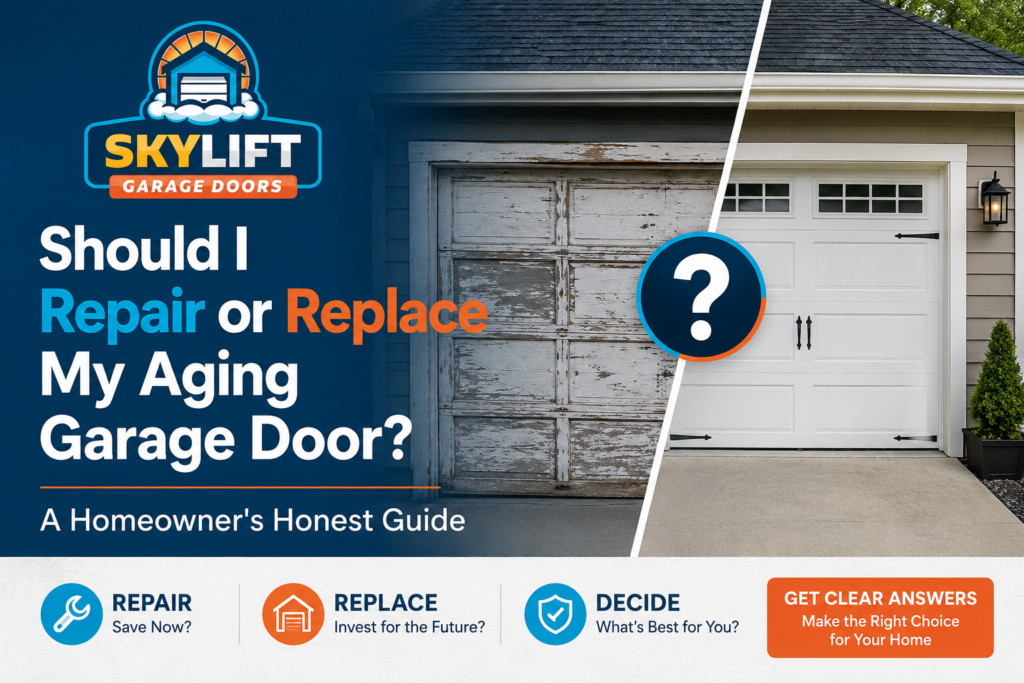
Your garage door shouldn’t sound like it’s fighting for survival every time you hit the opener.
But for a lot of homeowners, that’s exactly what starts happening. The door jerks halfway open, groans through the track, rattles the whole garage, or suddenly feels heavier than it used to. And once that starts, the question usually follows pretty quickly:
Do I repair this thing… or is it finally time to replace it?
Homeowners across Raleigh, Myrtle Beach, and Knoxville ask us this all the time, and honestly, the answer is rarely black and white. Some older garage doors still have years left in them with a few smart repairs. Others become money pits long before they completely fail.
A garage door is one of the largest moving systems in your home. It deals with constant use, shifting temperatures, humidity, storms, and wear on dozens of moving parts. The climate where you live plays a bigger role than most people realize, too. Coastal salt air around Myrtle Beach speeds up corrosion. East Tennessee freeze-thaw cycles put stress on aging materials. Raleigh humidity quietly destroys seals and lower panels over time.
That’s why the “repair vs replacement” decision should never be based on age alone.
Let’s breaks down what actually matters, what warning signs deserve attention, and how to tell whether your garage door still has life left in it — or whether replacing it now will save you frustration later.
Signs Your Garage Door Is Actually Wearing Out
Not every noisy garage door is dying.
Sometimes the issue is simple. Dry rollers, dirty tracks, loose hardware, or a slightly misaligned safety sensor can all cause strange operation without meaning the entire system is failing. Those are routine service issues.
Real aging tends to show up differently.
You may notice the door itself starting to sag or flex. Panels may look warped, dented, swollen, or uneven. Steel doors often begin showing rust around the lower sections and hinges. Older wood doors can absorb moisture and slowly lose their shape over the years, especially in humid regions like the Carolinas.
Balance problems are another major indicator. If you disconnect the opener and manually lift the door halfway, it should stay relatively in place. If it slams shut or feels extremely heavy, the system is no longer balancing properly. That usually points to worn springs, stressed hardware, or structural fatigue somewhere in the system.
Seals are another thing homeowners overlook until water starts getting inside.
The bottom seal and perimeter weather stripping help keep out moisture, drafts, dirt, and pests. Once those seals crack, flatten, or separate from the frame, outside air starts working its way into the garage year-round. In Raleigh, that often means rainwater tracking under the door during storms. Around Myrtle Beach, it means constant humidity creeping into the garage and accelerating corrosion on metal components.
A quick way to check your seals is simple:
Wait until daylight, close the garage completely, turn off the lights inside, and look around the edges of the door. If you can see sunlight coming through gaps along the sides or bottom, your weather sealing is no longer doing its job.
Then listen carefully when the door runs.
A healthy garage door should sound relatively smooth. Grinding noises, loud rattling, scraping metal, popping springs, or shuddering movement usually mean parts are wearing down somewhere in the system. Small sounds have a way of turning into larger failures if ignored for too long.
Regional weather conditions accelerate many of these problems.
In Myrtle Beach and along the South Carolina coast, salt-heavy air corrodes springs, hinges, brackets, and tracks much faster than inland areas. In Knoxville and surrounding East Tennessee communities, temperature swings constantly force materials to expand and contract, especially during winter. Raleigh’s combination of humidity and rain creates its own problems, particularly for lower door sections and weather seals that stay damp for long periods.
Most residential garage doors last somewhere between 15 and 30 years depending on maintenance, installation quality, usage, and environment. Near the coast or in areas with major seasonal changes, doors often age faster than homeowners expect.
When Repairing the Door Still Makes Sense
A lot of homeowners assume a major noise or sudden failure automatically means replacement.
Most of the time, it doesn’t.
In fact, many garage doors that appear “old” still have perfectly solid structural components and only need targeted repairs to keep running reliably.
Broken torsion springs are a good example. When a spring snaps, the door suddenly feels impossibly heavy and usually won’t open properly. It’s dramatic when it happens, but a broken spring alone does not mean the entire door system is worn out.
The same goes for:
- Frayed or snapped cables
- Worn rollers
- Cracked hinges
- Misaligned tracks
- Failing opener motors
- Weather seal replacement
- Sensor issues
If the actual door panels remain structurally sound and the system has otherwise been dependable, repairing individual components is usually the smarter financial decision.
This comes up often in newer communities around Raleigh, Wake Forest, Cary, Wendell, Zebulon, and Youngsville, where many homes are still within that 10–15 year range. The doors may need springs, rollers, adjustments, or opener work, but the systems themselves often still have a lot of usable life left.
The same pattern shows up around growing Knoxville suburbs and newer Myrtle Beach developments like Carolina Forest and Socastee.
One issue on an otherwise healthy garage door is usually a repair conversation.
Multiple recurring issues start pushing the discussion toward replacement.
When Garage Door Replacement Starts Becoming the Better Option
Most garage doors don’t fail all at once.
What usually happens instead is a slow pattern of problems that starts becoming more expensive and more frustrating over time.
First it’s the spring.
Then the rollers.
Then a cable frays.
A panel starts bowing. The opener struggles. The bottom section begins separating. Suddenly you’re scheduling service every few months for something different.
That’s usually the point where homeowners start asking whether continuing repairs still makes financial sense.
Structural damage matters here. If the panels are warped, sagging, or no longer sealing correctly, repairs become less effective because the actual body of the door is compromised. Dented sections that affect tracking or alignment can also create ongoing strain on the opener and hardware.
Insulation is another major factor that older doors often fail badly on.
Many homes built in the 80s, 90s, and early 2000s still have thin non-insulated steel garage doors. In Knoxville winters, that means cold air radiates directly through the garage. In Myrtle Beach summers, garages can become brutally hot and humid, forcing attached-home HVAC systems to work harder.
Modern insulated garage doors make a noticeable difference in both comfort and energy efficiency, especially in attached garages.
Safety upgrades matter too.
Older systems may lack modern auto-reverse safety features or reinforced wind-load protection. That becomes especially important in coastal Carolina communities where hurricane season brings significant storm pressure and wind exposure.
At some point, the decision stops being about cosmetic appearance and starts becoming practical:
- Is the system structurally reliable?
- Is it safe?
- Is it costing more to maintain every year?
- Is it protecting the home the way it should?
If the answer to several of those questions is “not really,” replacement usually becomes the smarter long-term investment.