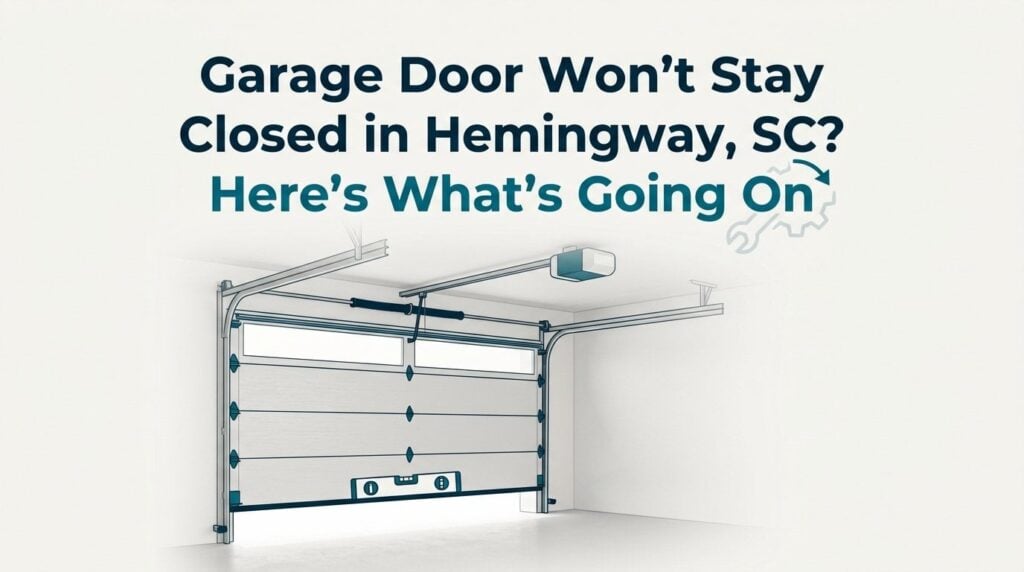
You hit the button, watch the door come down, and then — it reverses right back up. Or maybe it closes all the way, you walk inside, and ten minutes later you realize it’s crept back open on its own. Either way, your garage is sitting wide open, and you’re standing there wondering what in the world is going on.
This is one of the more frustrating garage door problems homeowners deal with, and it’s surprisingly common in Hemingway and the surrounding Williamsburg County area. The good news is that a door that won’t stay closed is almost always responding to a specific signal or mechanical issue — it’s not random, and it’s fixable. The not-so-great news is that South Carolina’s heat, humidity, and hurricane season all have a way of making these problems worse and more frequent.
Here’s a plain-language breakdown of what’s likely going on and why you should let a professional sort it out.
Is Your Garage Door Trying to Tell You Something?
When a garage door refuses to stay closed, it’s almost never just “acting up.” Modern garage door openers are built with safety logic that responds to real signals — from sensors, internal settings, or mechanical resistance. When something triggers that logic incorrectly, the door does exactly what it’s programmed to do: it reverses or reopens.
There are two main symptoms homeowners usually notice. The first is a door that reverses before it ever touches the ground — it comes down, gets close, and then heads right back up. The second is a door that closes fully but then slowly drifts or creeps back open on its own, sometimes within seconds, sometimes after a few minutes.
Both symptoms point to different causes, but the underlying principle is the same: something is telling the opener that the door shouldn’t be closed. Knowing which symptom you’re dealing with helps a technician narrow down the problem quickly.
What’s Most Likely Causing the Problem?
There are a handful of issues that come up again and again in Hemingway-area homes. Any one of these — or a combination — could be behind what you’re seeing.
Misaligned or Dirty Safety Sensors
At the base of your garage door tracks, there are two small photo-eye sensors that face each other and create an invisible beam. If anything interrupts that beam while the door is closing, the opener assumes something is in the way and reverses. That’s the safety system working as intended.
The problem is that those sensors can get bumped out of alignment, coated in dust, or covered in spider webs — especially in humid South Carolina conditions where grime builds up faster than you’d expect. When the sensors can’t “see” each other clearly, the opener reads it as an obstruction every single time, even when the path is completely clear.
Close-Limit Settings Out of Calibration
Your opener has a programmed setting that tells it exactly how far the door needs to travel to reach the ground. If that setting drifts — which can happen gradually over time or after a power surge — the opener may think the door has already hit the floor when it hasn’t. At that point, it interprets the continued downward travel as resistance and reverses to protect against damage.
This is a common cause of the “reverses just before touching the ground” symptom, and it’s something that needs to be recalibrated by a technician with the right equipment.
Worn or Warped Bottom Weather Seal
The rubber seal along the bottom of your door is supposed to create a snug barrier against the ground. But when that seal gets cracked, warped, or bunched up from age and heat exposure, it can create uneven resistance as the door closes. The opener senses that resistance and interprets it as an obstruction — triggering the auto-reverse feature even though nothing is actually blocking the door.
In Hemingway’s climate, rubber seals take a beating. Heat and humidity cause them to deteriorate faster than manufacturers’ timelines often suggest, and a seal that looked fine last season may be causing problems by the time summer rolls back around.
How Does Hemingway’s Climate Make This Worse?
Hemingway sits about 50 to 60 miles inland from Myrtle Beach, but that doesn’t mean it escapes the coastal climate. Salt air carried in from the Grand Strand and Georgetown County coast still reaches this area, and the Lowcountry heat and humidity are very much present from spring through fall.
Humidity and Heat
High humidity causes rubber components — weather seals, bottom strips, and weatherstripping along the sides and top of the door — to swell, crack, and warp faster than they would in a drier climate. That degradation directly affects how the door seats at the ground, which feeds right into the resistance and sensor issues described above.
Salt Air Corrosion
Even inland, salt air accelerates corrosion on metal hardware. Sensor brackets, track components, spring hardware, and wiring connections are all vulnerable. Corroded sensor brackets can shift slightly over time, knocking sensors out of alignment without any obvious physical impact. Corroded wiring connections can cause intermittent sensor failures that are genuinely hard to trace without hands-on inspection.
Hurricane Season and Storm Activity
Atlantic hurricane season brings heavy rain, strong winds, and sometimes significant structural stress to homes throughout South Carolina. A strong storm can shift a door frame just enough to throw sensors out of alignment, or drive debris into the track or sensor path. These are the kinds of subtle changes that don’t always show up immediately but start causing problems weeks later.
Why This Is a Security Problem Worth Taking Seriously
A garage door that won’t stay closed isn’t just annoying — it’s a real security vulnerability. An open garage gives easy access to your vehicles, tools, and in many homes, a direct entry point into the house itself. Leaving that exposure unaddressed overnight, even once, is a risk that’s easy to underestimate.
There’s also a safety dimension beyond security. The auto-reverse system exists specifically to protect people and pets from being struck by a closing door. When that system is malfunctioning — whether it’s reversing when it shouldn’t or, in some cases, potentially failing to reverse when it should — the safety net you’re relying on isn’t working correctly.
Some homeowners are tempted to tape over sensors or manually adjust settings to force the door to stay closed. This is genuinely dangerous. Bypassing or overriding safety sensors disables a critical protection feature and can create a hazardous situation for anyone in or near the garage. It also won’t fix the actual problem — it just hides it temporarily while making things worse.
What a Skylift Technician Will Check When They Arrive
When a Skylift Garage Doors technician comes out to a Hemingway home for this type of call, they’re not just looking at one thing. A door that won’t stay closed can have a single cause or several contributing factors, so a thorough inspection covers the whole system.
Sensor alignment and condition: The technician will check whether both photo-eye sensors are properly aligned, clean, and free of corrosion — including the wiring and mounting brackets, which are common failure points in coastal SC humidity.
Opener limit and force settings: Close-limit and force settings can be recalibrated precisely to match the actual travel distance of your door. This is a common fix for doors that reverse just before touching the ground.
Track alignment and hardware condition: Bent or shifted tracks can create resistance the opener misreads as an obstruction. The technician will check for any hardware issues that could be contributing to the problem.
Weather seal and spring balance: A warped bottom seal or an imbalanced spring can both trigger the auto-reverse feature in ways that aren’t immediately obvious. These get checked as part of a complete diagnosis.
Common Questions from Hemingway Homeowners
My door closes fine sometimes but not others. What causes that?
Intermittent problems are often a sign of a sensor that’s borderline misaligned or a wiring connection that’s slightly loose. Heat and humidity cause components to expand and contract throughout the day, which can make the problem appear and disappear without any obvious pattern. A technician can identify these borderline conditions during an inspection.
Can I just block the sensors to keep the door closed?
No. Blocking or bypassing the sensors disables a critical safety feature that exists to prevent serious injuries. It’s also not a fix — the underlying problem will still be there, and now you’ve removed a protection layer in the process. Please don’t do this.
Does Skylift Garage Doors serve Hemingway?
Yes. Skylift serves the greater Myrtle Beach area and the South Carolina coastal region, including Hemingway and surrounding Williamsburg County communities. Contact the team to schedule a service visit.
Getting This Fixed the Right Way
A garage door that won’t stay closed is a solvable problem. It’s not a sign that you need a whole new door — in most cases, it comes down to sensors, settings, a worn seal, or some combination of those things. But it does need professional attention, not guesswork or improvised fixes.
Skylift Garage Doors serves Hemingway and the surrounding South Carolina area, and our technicians understand exactly how the local climate affects these systems. Whether it’s a sensor knocked out of alignment by a recent storm or a bottom seal that’s finally given out after too many South Carolina summers, we can diagnose it correctly and get your door working reliably again.
If you’re ready to stop dealing with a door that won’t cooperate, Schedule Now! and we’ll get a technician out to you. And if you want to stay ahead of problems like this in the future, ask us about the Skycare Club Membership — our annual maintenance plan designed to catch these issues before they turn into urgent calls.