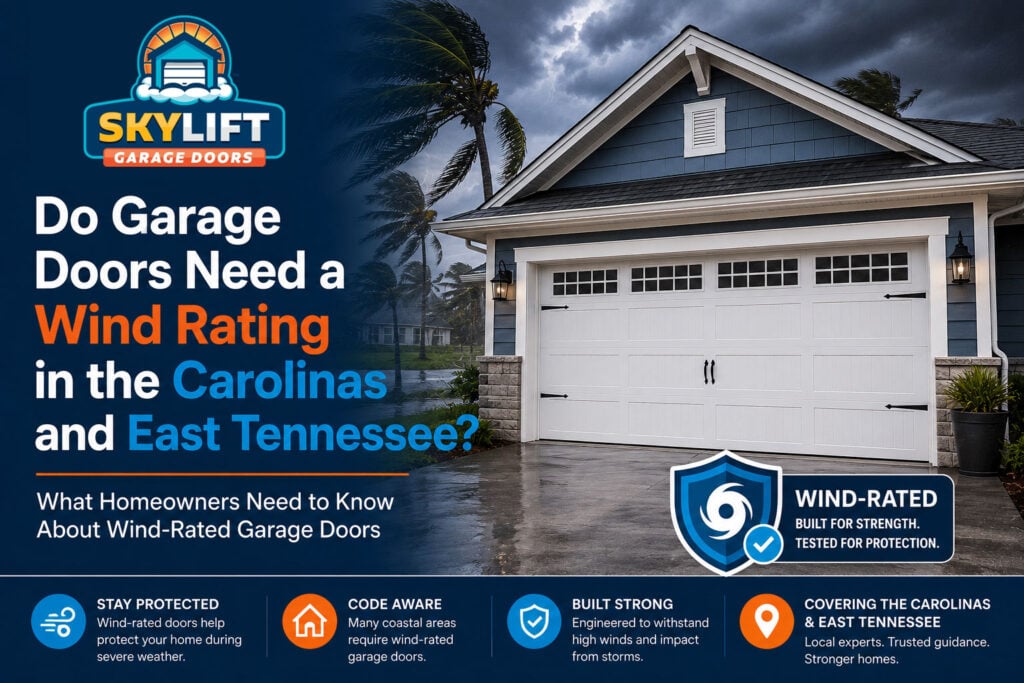
Whether garage doors need wind rating in your region depends on local building codes and storm exposure, but the stakes are high either way. This guide explains wind rating requirements across the Carolinas and East Tennessee, helping homeowners in Myrtle Beach, Raleigh, and Knoxville understand what their largest home opening needs to withstand during hurricanes, tropical systems, and severe thunderstorms.
Picture this: it’s August, and you’re watching the weather app on your phone as a tropical system churns up the South Carolina coast. Or maybe you’re in Raleigh, and a neighbor just told you their garage door buckled inward during last week’s severe thunderstorm. Either way, the same question starts forming in your mind — does my garage door actually need to be rated for wind?
It’s a fair question, and the honest answer is: it depends. It depends on where you live, what your local building codes require, and what kinds of storms your area actually sees. What doesn’t vary is the fact that your garage door is the largest opening on your home, and when it fails in high wind, the consequences can go far beyond a bent panel.
We install and repair garage doors across Myrtle Beach, Raleigh, and Knoxville every week. We see firsthand what storm damage looks like, what older doors can and can’t handle, and what homeowners in each of these markets actually need to know. This isn’t a code lecture. It’s practical guidance from a local team that deals with this stuff year-round.
Why Wind Ratings Matter More Than You Might Think
A wind rating tells you how much wind pressure a garage door can withstand before it fails structurally. That pressure is measured in pounds per square foot (PSF), and it accounts for two directions: positive pressure, which is wind pushing inward against the door, and negative pressure, which is the suction effect pulling the door outward as wind moves past it.
Standard residential garage doors aren’t designed with either of those forces in mind. They’re built to open, close, and look good. A wind-rated door is built differently from the ground up: heavier-gauge metal garage doors with reinforced horizontal bracing struts bolted across the back of each section, upgraded track and bracket systems, and sometimes impact-resistant glazing if there are windows in the door.
Here’s why this matters so much. Your garage door is typically the largest single opening on your home, often anywhere from 8 to 16 feet wide. When that opening fails during a storm, wind rushes inside. Internal pressure builds rapidly, and that pressure has to go somewhere. In serious cases, it lifts the roof from the top or blows out the walls from the inside. This isn’t a worst-case hypothetical — it’s a well-documented cause of catastrophic structural damage in hurricane and severe storm events.
Wind-rated doors are tested to standards like ASTM E330, which evaluates structural performance under simulated wind loads, and ASTM E1886/E1996, which covers impact resistance for wind-borne debris. If you’re in a wind-borne debris region, you may need a door that can handle both the pressure and the flying objects that come with a serious storm.
The difference between a standard door and a wind-rated door isn’t always visible from the outside. But during the storm, that difference is everything.
What the Weather Actually Looks Like in Our Three Markets
Not every area faces the same storm threats, and that shapes what kind of door protection makes sense where you live.
Myrtle Beach and the SC Coast:
This is the most straightforward case. Horry County sits squarely in a wind-borne debris region as defined by the International Residential Code, and for good reason. Direct hurricane landfalls, tropical storm remnants, and powerful coastal nor’easters are all part of life here. Salt air adds another layer of risk that doesn’t show up on a wind map: it accelerates corrosion on springs, cables, hinges, and tracks. A door that was structurally sound when it was installed can lose significant integrity over time simply because the hardware holding it together has been quietly corroding in the coastal humidity. Wind-rated construction, including garage doors, is often required for new builds and major replacements in coastal SC counties. For homeowners in this area, choosing the best garage doors for Myrtle Beach means factoring in both wind resistance and salt air durability.
Raleigh and the Triangle:
Raleigh doesn’t take direct hurricane hits the way the coast does, but it sees the remnants. Tropical systems regularly push inland across North Carolina, bringing sustained winds and gusts that can exceed what a standard residential door handles safely. Add in the severe thunderstorm season, which runs practically year-round in the Piedmont, and the occasional tornado that touches down in Wake County, and you have a real wind risk even well inland. North Carolina’s residential building code references ASCE 7 wind speed maps, and Wake County has minimum design wind speed standards that apply to new construction and permitted replacements.
Knoxville and East Tennessee:
This one surprises people. Knoxville isn’t a coastal city, and East Tennessee doesn’t have the hurricane exposure of the Carolinas. But the valley geography of the region does something interesting to wind: the ridges and gaps of the Great Smoky Mountains and the surrounding terrain can channel and accelerate winds during severe thunderstorms. Spring severe weather season brings straight-line winds and occasional tornadoes to the Tennessee Valley more often than many homeowners realize. The wind damage risk here is real, even if it doesn’t make the same headlines as a coastal hurricane.
Call Your Local Team(844) 755-5149
Building Codes and When a Wind-Rated Door Is Actually Required
Let’s talk about what the rules actually say, without turning this into a code manual.
In South Carolina’s coastal counties, including Horry County where Myrtle Beach is located, local building codes tied to the state’s wind-borne debris region designations often mandate wind-resistant garage doors for new construction. If you’re replacing a garage door and pulling a permit in these areas, you’ll likely need to meet those wind resistance requirements. The specific threshold depends on your location within the county and the applicable wind speed zone. Homeowners looking at insulated garage doors for coastal homes will find that many wind-rated options also deliver excellent thermal performance.
In North Carolina, the state residential code is based on the IRC and references ASCE 7 wind speed maps. The requirements get stricter as you move toward the coast, but even inland counties like Wake County have minimum design wind speed standards that apply to permitted construction. If you’re doing a full garage door replacement and pulling a permit in Raleigh, your installer needs to know what those standards are and spec the door accordingly.
In Tennessee, there aren’t the same coastal wind mandates, but local jurisdictions still require permits and inspections for garage door replacements in many cases, and those inspections reference wind load standards. Beyond code, insurance companies in severe weather markets are increasingly paying attention to wind resistance features. Some homeowners in all three of our markets have found that upgrading to a wind-rated door affects their homeowner’s insurance premium. It’s worth a conversation with your insurer before you decide what to install.
The practical takeaway: if you’re replacing a garage door and not sure what’s required in your area, a qualified local installer will know. This is one of the reasons pulling a permit and working with a professional matters, not just for compliance, but for your own protection.

Red Flags That Your Current Door Isn’t Ready for a Storm
You don’t need a storm to figure out whether your door has a problem. There are signs you can look for right now.
Bowing or flexing panels:
If your door visibly bows inward or outward during strong wind, even without failing completely, that’s a sign the panels lack adequate structural reinforcement. A door with proper bracing struts doesn’t flex like that.
Gaps along the bottom seal or sides:
Weatherstripping that’s cracked, compressed, or pulling away from the frame isn’t just an energy efficiency issue. Those gaps allow wind pressure to work against the door from the edges, which puts additional stress on the hardware and panels during a storm.
Rattling or shaking tracks:
Some vibration during operation is normal. But if your tracks rattle noticeably when wind picks up, or if the door shakes in its frame during a storm, the track and bracket system may not be adequate for the wind loads your area can produce.
Single-layer panels with no bracing struts:
Look at the back of your door panels from inside the garage. If you see flat, unbraced single-layer steel with nothing bolted across the sections, that door has no meaningful wind reinforcement.
Age matters too. Doors that are 15 to 20 years old in coastal or high-humidity environments like Myrtle Beach or the Raleigh area can have corroded springs, weakened cables, and hardware that’s lost structural integrity even if the door still opens and closes fine day-to-day. The mechanism works until the moment it doesn’t, and that moment often comes during a storm. If you’re unsure about your door’s condition, scheduling a garage door tune-up is a smart first step.
A professional inspection can tell you whether adding aftermarket bracing is a reasonable fix or whether the door itself needs to be replaced. That’s not always an easy conversation, but it’s an honest one.
What a Wind-Rated Door Upgrade Actually Involves
If your door needs an upgrade, you have a few paths depending on the door’s current condition and your local wind zone requirements.
For some doors, horizontal bracing struts can be added to existing panels. These are steel tubes that bolt across the back of each section, significantly improving the door’s ability to resist wind pressure without replacing the entire unit. This is a practical option when the door itself is otherwise in good shape and the wind zone requirements don’t call for a fully rated replacement.
For older doors, doors in high wind zones, or situations where local code requires a wind-rated door for a permitted replacement, a new door is the right answer. Wind-rated insulated garage doors for energy efficiency are worth a second look here because they do more than handle storm pressure. The polyurethane or polystyrene core that gives them their insulating value also adds panel rigidity. In the hot, humid summers across Myrtle Beach, Raleigh, and Knoxville, and in the chilly winters that East Tennessee sees regularly, that insulation pays back in energy efficiency year-round.
Installing a wind-rated door isn’t always a simple swap. Depending on the door’s weight and wind load rating, it may require heavier springs, upgraded tracks and brackets, and reinforced framing around the opening. A qualified technician handles all of that as part of the installation. This is another reason to work with someone who knows what they’re doing and knows your local code requirements, not just whoever has the lowest price online. A new door is also an opportunity to consider whether adding windows to your garage door makes sense, keeping in mind that wind-rated doors with glazing use impact-resistant options.
The investment in a properly rated door is real, but so is the cost of a door that fails during a storm and takes part of your roof with it. Beyond storm protection, a quality replacement can also boost your garage doors and home resale value.
Protecting Your Home Before the Next Storm Season
Whether you’re watching hurricane season from the coast in Myrtle Beach, living in the growing suburbs around Raleigh, or settled into the Tennessee Valley near Knoxville, your garage door’s ability to handle wind is a real part of your home’s storm resilience. It’s not just about code compliance. It’s about what happens to your family and your home when a serious storm comes through.
If you haven’t had your garage door inspected recently, that’s the right place to start. Our team at Skylift Garage Doors serves all three of these markets and knows exactly what the local conditions and code requirements look like in each area. We can tell you honestly whether your current door is adequate, whether bracing is an option, or whether a replacement makes more sense.
Our Skycare Club maintenance plan is also worth considering as a way to stay ahead of the wear and corrosion that our regional climate accelerates. Regular inspections catch the hardware degradation, weatherstripping failure, and structural issues that build up quietly over time, before a storm makes them obvious in the worst possible way.
Don’t wait until you’re watching a forecast and wondering if your door is going to hold. Schedule Now and let us take a look before storm season puts it to the test.