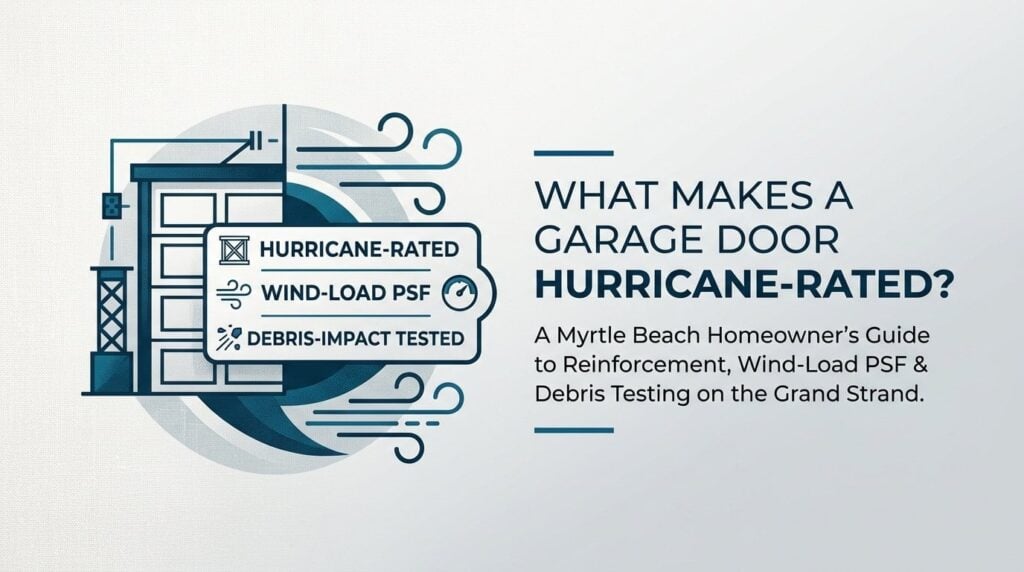
A hurricane-rated garage door is one that has been built with reinforcement, tested to a specific wind-pressure level, and in many cases tested against flying debris, with a label to prove it. There’s no single universal “hurricane-rated” standard, so the phrase only means something when it’s backed by numbers and a test. Here’s how to read those numbers if you own a home in Myrtle Beach or elsewhere on the Grand Strand.
What Does the Wind-Load Rating on the Label Mean?
Wind-load, also called design pressure, is measured in pounds per square foot (psf). You’ll often see two numbers, something like +30 / -35. The positive number is pressure pushing the door inward. The negative is suction pulling it outward, which is what happens on the leeward side of a house. A rated door has to hold up under both.
Size matters here. A 16-foot double door has a lot more surface to flex than a 9-foot single, so the same model can carry different ratings depending on its width. A rating on a brochure for one size doesn’t automatically carry over to yours.
The psf figure is also not the same thing as wind speed. Engineers match the pressure a door must withstand to the design wind speed for a building’s location and exposure. A house on open marsh or along the Intracoastal Waterway sees harsher exposure than one tucked into a wooded lot farther inland, so the number that makes sense for each can differ.
If what you really want to know is whether your address requires a wind-rated door, we cover that separately on our page about whether garage doors need a wind rating. Here, the point is simply what the number means: how much pressure the tested door assembly held without failing.
How Is an Impact Rating Different From a Wind-Load Rating?
They’re two separate tests. For impact, a “missile,” typically a piece of lumber, is fired at the door at a set speed. Then the door is cycled through positive and negative pressure to see whether it stays intact and attached. Passing means the door took a hit and kept working as a barrier.
This matters because the garage door is often the largest opening in the house. If it breaches, wind rushes in and pressure builds inside, pushing up on the roof and out on the walls. That’s how a failed garage door can turn into a much bigger structural problem.
Think about what’s loose around a Myrtle Beach neighborhood in a tropical storm: roof shingles, fence boards, patio chairs, trash cans, branches from the live oaks. In fast-growing developments with young landscaping and lots of construction debris nearby, there’s plenty to throw around. Our tips for preparing your garage door for a tropical storm cover what to secure before the weather turns.
How to tell what your label covers
A door can be wind-load rated without being impact rated. Look at the label or data sheet. If it lists only psf values, assume wind-load only. If it also references an impact test standard or says “impact” and “large missile” or “small missile,” that’s the second test. When it’s unclear, ask for the product data sheet rather than guessing.
What Is Actually Different Inside the Door?
Put a standard builder-grade door next to a rated one and the differences show up quickly.
- Reinforcement: horizontal steel struts or bars run across the sections to keep panels from bowing under pressure.
- Heavier materials: thicker-gauge steel skins, plus sturdier stiles and end caps where the hardware attaches.
- Stronger hardware: reinforced hinges, heavier-duty track, and beefier mounting brackets, often double-bracketed on the door and jamb.
- Coastal finishes: salt air eats ordinary hardware. Look for corrosion-resistant finishes and galvanized parts.
Anchoring is just as important. Track needs to be fastened into solid framing, not just drywall or thin trim. A strong door on weak mounting is only as good as its weakest bolt.
One caution: a retrofit strut kit on an older door isn’t the same as a tested, labeled assembly. Added bracing can help stiffen a door, but the rating belongs to the specific combination that passed testing. If you’re considering bracing, have a technician look at your door first, since a garage door showing signs of wear may need repair before any reinforcement makes sense.
Which Testing Standards and Labels Should You Look For?
Garage doors are tested as a complete assembly: door, track, hardware, and the installation method. The standards you’ll most often see referenced are ANSI/DASMA 108 and ASTM E330 for wind pressure, and ASTM E1886 and E1996 for impact. Versions get updated, so treat this as a list of names to look for and confirm the current editions with the manufacturer or your building department.
You may also see Florida Product Approval or a Miami-Dade Notice of Acceptance (NOA) mentioned, even on doors sold in the Carolinas. Those come from Florida’s stricter high-velocity hurricane zone programs. They signal that a product went through demanding testing, but they aren’t automatically what South Carolina requires. What your address needs is a question for the local building department.
When you’re comparing doors, ask for:
- A permanent label or product data sheet showing the psf rating.
- The door size that rating applies to.
- Whether it covers impact, and under which standard.
- The required installation details, such as track and fastening.
Be wary of marketing language. “Storm-ready,” “heavy-duty,” and “hurricane-grade” aren’t ratings. A real one has a number and a named test standard behind it. Codes and standards change, so as of 2026 the local building department still has the final word on what applies to your home.
How Do You Choose the Right Rating for a Coastal Home?
Start with where the house sits. Oceanfront, a Grand Strand community near open water, and a lot farther inland each face different exposure. Then factor in door width, since wider doors need more from the design. Material choice plays a role too, and our guide on choosing the right garage door material walks through the tradeoffs.
The door is only one part of the system. Humidity and salt wear on tracks, rollers, springs, and openers year-round, long before storm season arrives. Weather seals dry out and crack after summer heat and heavy rain, and wind-driven water finds every gap. Regular garage door maintenance is the best defense against that slow wear.
The most common mistakes we see:
- Replacing the door but leaving old tracks and loose fasteners in place.
- Skipping a check of the opener’s manual release before a storm, then finding it stuck when power goes out.
- Assuming a door is rated because it looks heavy.
If you’re looking at options, our Myrtle Beach new garage doors page is a good place to start, and our look at insulated garage doors for coastal homes shows what holds up in salt air. And our Skycare Club Membership includes annual checks, which is a practical way to catch corroded hardware, worn seals, and loose fasteners before they matter.
Quick Questions Myrtle Beach Homeowners Ask
Bracing often helps stiffness, but it doesn’t turn your door into a certified rated one. Have a technician look at the door, track, and mounting before you decide.
Typically, yes, because of the heavier materials, extra hardware, and testing behind it. Prices vary by size and rating, so ask for a written quote that spells out exactly what’s included.
Yes. Check the tracks, seals, and opener release, and clear loose items from the driveway and yard so they don’t become projectiles.
What to Look For Before You Buy a Hurricane-Rated Door
A true hurricane rating is a labeled wind-load number, often paired with an impact test, on a door built with reinforced hardware and installed the way it was tested. If a door can’t show you that, it isn’t rated, whatever the brochure says.
For whether your area calls for one, read our guide on wind-rated garage door requirements. And if you’d like someone to inspect your current door or quote a new one, our Myrtle Beach team is happy to help. Schedule Now!