You hit the button, the door starts moving, and then — nothing. A grinding noise, a tilt, one side hanging lower than the other. Maybe it stopped halfway down and won’t budge. If you’re a homeowner in Knightdale and this just happened, you’re probably staring at your garage wondering what went wrong and whether you can just nudge it back into place.
An off-track garage door is one of those problems that looks alarming because it is alarming. It’s not a minor inconvenience you can work around. But it’s also not a mystery. There are clear reasons this happens, and there’s a clear path to getting it fixed safely. The key word there is safely, because this is not a repair to attempt on your own.
Here’s what’s going on, why it happens in homes like yours, and what to do next.
What Does an Off-Track Garage Door Actually Look Like?
The signs are usually hard to miss. The door moves unevenly as it opens or closes, with one side traveling faster or slower than the other. You might hear a scraping or grinding sound as the panels drag against the track. In more obvious cases, one side of the door sags visibly lower, or the door stops mid-travel and won’t go up or down at all.
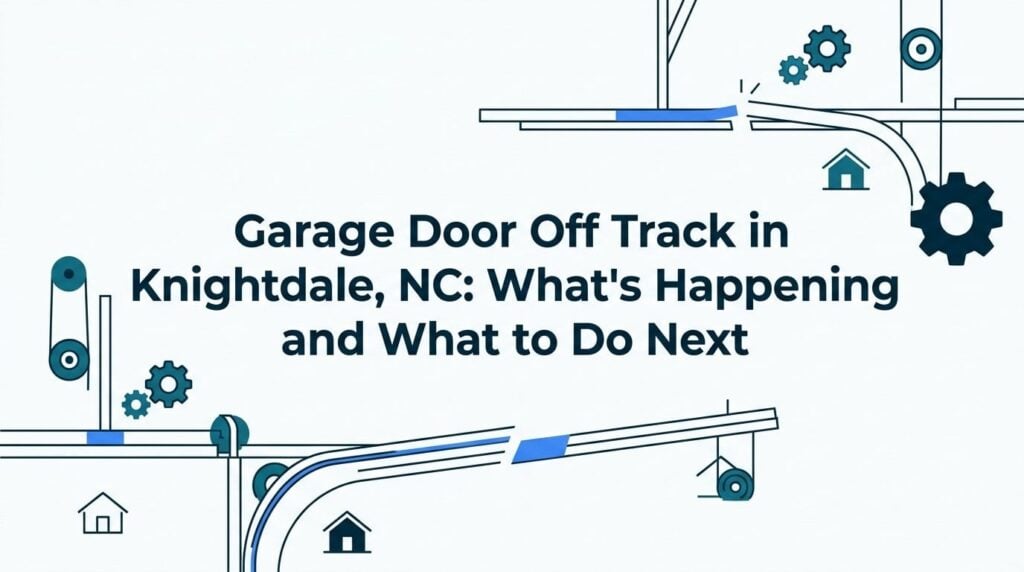
What’s happening mechanically is this: your garage door rides along a pair of metal tracks on either side of the opening. Small rollers attached to each panel fit into a channel in those tracks and guide the door through its travel. When a door goes “off track,” it means one or more of those rollers has jumped out of the channel — the panel has lost its guide and is now moving on its own, or not moving at all.
One thing worth knowing: a door that’s slightly off track may still partially open and close. That’s actually where a lot of homeowners get into trouble. The door still moves, so it seems usable. But every cycle puts more stress on the misaligned section, bends the track further, and risks a sudden drop or jam. If your door is showing any of these signs, stop using it. Don’t run it up and down hoping it’ll correct itself.
Why Do Garage Doors Jump the Track?
There are a few common causes, and all of them are worth understanding so you know what a technician will be looking for when they arrive.
Vehicle Impact
This is probably the most common cause in busy households. Someone backs into the door, clips the bottom panel, or misjudges the clearance in a tight two-car garage. It doesn’t have to be a major collision — even a slow bump at the wrong angle can knock a panel out of alignment. In Knightdale’s newer subdivisions, where attached two-car garages are standard but sometimes tight on space, this happens more often than most homeowners want to admit.
Worn or Broken Rollers
Rollers take a beating over years of daily use. Plastic rollers can crack and chip. Steel rollers can corrode, especially in North Carolina’s humid climate where moisture gets into the hardware and accelerates rust. When a roller breaks or wears down significantly, the panel it supports loses its guide in the track. The door keeps moving, but that section isn’t being controlled properly — and eventually it slips out.
Broken Cable or Spring
This is the more serious scenario. Your garage door’s cables and springs work together to manage the door’s weight and keep tension balanced on both sides. When a cable snaps or a torsion spring breaks, that balance disappears instantly. One side of the door becomes heavier than the other, and as the opener tries to move it, the door shifts sideways and can come off the track under its own weight. If you heard a loud bang before the problem started, a broken spring is likely involved.
How Does Knightdale’s Climate Make This Worse?
Living in the Triangle region of North Carolina means dealing with conditions that are genuinely hard on garage door hardware. Summers here are hot and humid. Winters can bring ice storms that freeze tracks and add unexpected weight to door panels. And the area gets significant rainfall throughout the year.
That humidity is the quiet culprit that most homeowners don’t think about. Moisture accelerates rust on rollers, track hardware, and cable components. Over time, corroded rollers don’t glide the way they should — they stick, skip, and eventually fail. Track mounting brackets can loosen as metal expands and contracts through seasonal temperature swings, which gradually throws the alignment off.
There’s also a newer-home factor worth mentioning. Knightdale has grown quickly over the past decade, with residential developments spreading throughout the area along US-64 and into surrounding Wake County. A lot of those homes have garage doors that were installed by the builder and have never been professionally serviced since. No lubrication, no roller inspection, no hardware check. That deferred maintenance adds up, and it often shows up as an off-track door or a broken spring a few years into ownership.
Why You Shouldn’t Try to Fix This Yourself
We understand the instinct. The door looks like it just needs to be pushed back into the channel. How hard could it be?
Here’s the reality: a standard residential garage door weighs anywhere from 130 to over 200 pounds depending on the material and insulation. That weight doesn’t disappear when the door comes off track — it shifts. Trying to force a panel back into the track without first understanding what caused the problem, and without releasing spring tension properly, can cause the door to drop suddenly or shift in a way that’s genuinely dangerous.
If a broken torsion spring is involved, the risk level goes up significantly. Torsion springs store a large amount of mechanical energy even when the door is down. Handling spring components without the right tools and training has caused serious injuries. This isn’t a scare tactic — it’s a straightforward safety reality.
There’s also the damage angle. Homeowners who attempt to force a door back on track sometimes bend the track further, crack a panel, or strip the opener’s gear drive by running it against a stuck door. What starts as a roller and track repair can become a full panel or track replacement. The repair cost goes up, not down.
What Will a Technician Actually Do?
When a Skylift technician arrives, they’re not just going to put the door back on the track and call it done. The first step is figuring out what caused the problem in the first place, because putting a door back on track without fixing the root cause means it’ll happen again.
Full System Inspection
The technician will check the tracks, rollers, cables, springs, and opener. They’re looking at the whole picture — not just the section that came off, but what led to it. Bent track? Cracked roller? Frayed cable? Broken spring? Each of those has a different fix.
Realignment and Component Replacement
If the track is bent, it gets realigned or replaced. Worn rollers get swapped out. Cable tension gets checked and corrected. The door is then tested through a full open-and-close cycle to confirm everything is tracking properly before the technician leaves.
Opener Assessment
If the door was forced or run while off track, the opener may have taken damage too. Stripped gears and burned-out motors are a common secondary problem when homeowners keep running the opener against a stuck door. A good technician will check for that and flag it before it becomes its own issue.
Quick Answers to Common Questions
No. Even minor misalignment tends to worsen with each cycle. What starts as a small issue can become a full drop or a jammed door that won’t open at all. Stop using it and call for service.
Most off-track repairs can be handled in a single visit. The timeline depends on what caused the problem and whether any components need replacement, but it’s typically not an all-day job.
It depends on the cause. If a vehicle caused the damage, your auto or homeowner’s policy may cover it. Wear-and-tear failures — like corroded rollers or a worn cable — typically aren’t covered. Worth a call to your insurance agent to check.
Don’t Wait on This One
An off-track garage door isn’t the kind of problem that gets better on its own. The longer it sits in a damaged state — or worse, gets used — the more components get stressed and the more expensive the repair becomes. For Knightdale homeowners, the smart move is to stop using the door, disconnect the opener if you can do so safely, and call for a professional assessment.
Skylift Garage Doors serves Knightdale and the surrounding Wake County area with same-day service and technicians who know what to look for. If you want to avoid ending up in this situation again, ask about the Skycare Club Membership — our annual maintenance plan that catches worn rollers, corroded hardware, and loose track brackets before they turn into emergency calls.
Schedule Now! and get your door back on track safely.